
One way Baje could start
A Travel Essentials Brand
A name stitched on the first cable wallet, with room for the travel range that follows.
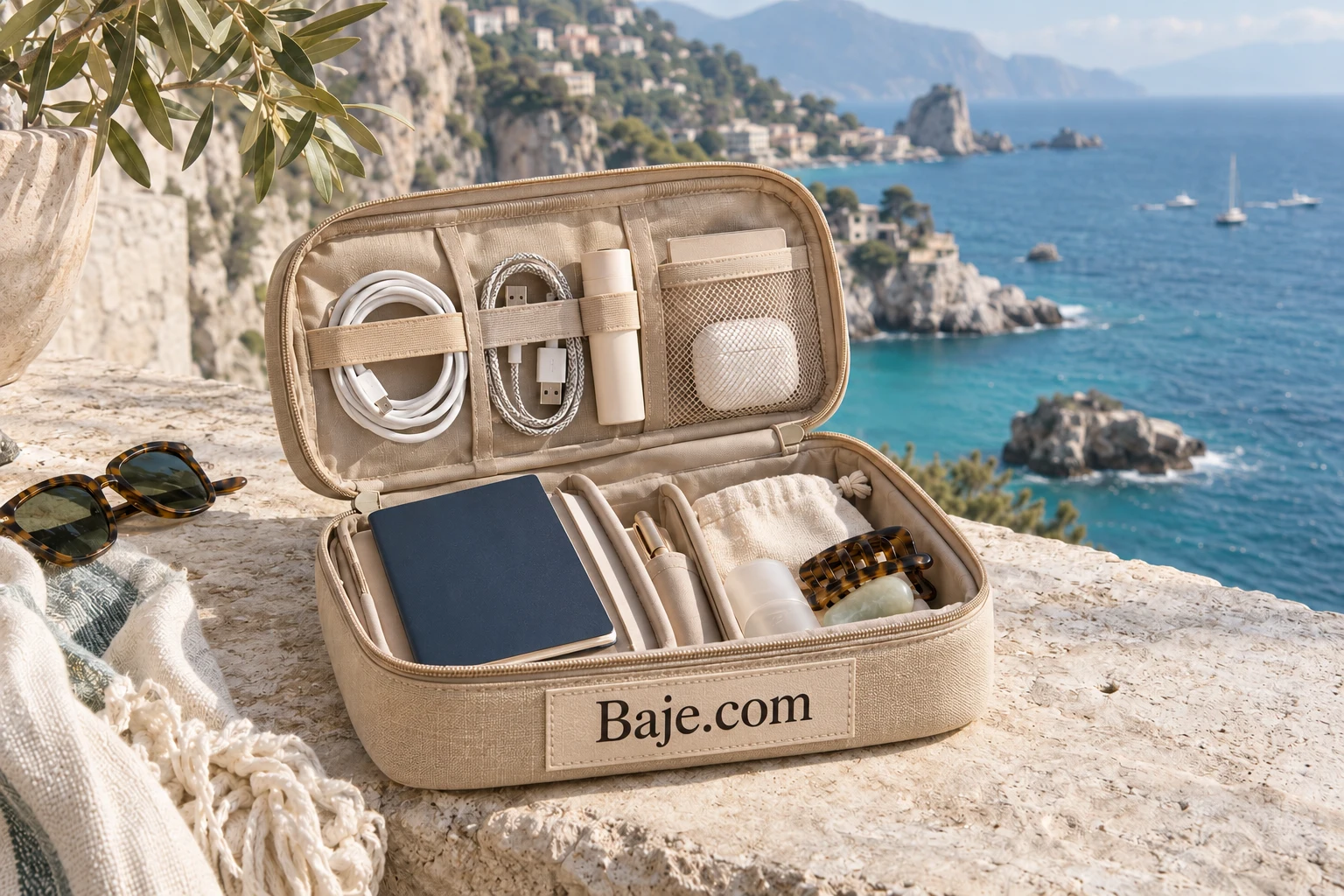
A useful travel collection starts with a moment that keeps going wrong. A charging cable disappears into a bag, a damp toothbrush touches clean clothing, or a traveler empties every pocket to find a passport. Baje.com could support a focused accessories brand that solves one of those small interruptions. This is an illustrative business concept. The domain is available for acquisition; products, customers and an operating business are not included.
Pick the traveler before the product
The first customer could be someone who takes frequent two-night trips with one carry-on. That is a better brief than “people who travel.” It tells a founder where the product lives, how often it gets packed, and which tradeoffs matter. A person carrying a laptop and a change of clothes may value quick access more than maximum capacity. Someone checking a suitcase may need a different shape entirely. Interview a small group about their last trip, then ask them to show their current bags. A tidy answer in an interview is less useful than seeing three tangled cables in a side pocket.
Choose a repeat friction that appears across several bags. Record the workaround as well as the complaint. A rubber band around a charger is a competing solution, even if nobody calls it a product. The organizer must earn the extra space it occupies. If the customer already manages the problem easily, a prettier pouch may be a gift item rather than a daily essential. That is still a possible business, but it changes the product brief and the way it should be sold.
Make one organizer do one job
An initial offer might be a flat cable wallet with three visible compartments and a pocket sized for a particular charging brick. Start with one size, two colors and no bundled electronics. A founder could prototype a soft sample before commissioning polished packaging. Test the empty dimensions and the loaded thickness. A wallet that looks compact in a studio photograph can become awkward when it contains the objects pictured beside it.
Ask testers to pack their own gear, rather than a matching demonstration kit. Watch where their hands hesitate. Check whether a short cable slips out, a zipper catches a lead, or a stiff panel prevents the wallet from fitting in the bag they actually use. Photograph the packed configuration with permission and mark the failure points. The next version should change a specific problem, such as a compartment opening, rather than accumulating features because every tester suggested something different.
Keep the promise within the product
Travel accessories invite broad claims. A pouch should not be described as making every journey stress-free. A precise promise is easier to support: three compartments make it possible to separate a cable, an adapter and a charging brick. Show the loaded product and publish measurements. Explain what is supplied and what is used only for demonstration. A customer should not have to inspect the fine print to learn that the charger in a photograph is not part of the purchase.
Security requirements are another boundary. The TSA travel checklist is a better reference for screening questions than a product slogan. A founder should verify current official rules before making any airport-related compatibility claim. The cable wallet can be presented as an organizer without suggesting that it provides privileged treatment at a checkpoint. Its value needs to survive an ordinary trip from home to a hotel room.
Sell the packing demonstration
One credible distribution path is a direct storefront supported by short packing demonstrations. Show the organizer beside a common bag, fill it with ordinary equipment, and place it inside the bag in one continuous sequence. That tells a prospective buyer more than a montage of airport interiors. Each demonstration should answer a different question: what fits, how it opens on a small table, and how much space remains after packing. Product measurements belong close to the purchase decision.
A small retailer that already sells bags could be a second test channel. Bring a sample, a concise product sheet and the wholesale assumptions. Ask how customers handle comparable accessories, where the item would sit, and what packaging information staff need. A retailer's interest is useful feedback but is not a purchase commitment. Avoid buying a large production run around an encouraging conversation. Confirm the practical terms and inspect the costs before treating distribution as solved.
Build the unglamorous parts early
Execution requires a repeatable specification, supplier communication, sample review, packaging, shipping preparation and a returns process. Record zipper type, seam placement, material description and acceptable dimensional variation. Keep an approved sample for comparison when production arrives. Inspect the first units before sending them to customers. The person writing product copy should know which claims were tested, which details are supplier statements, and which questions remain open.
Calculate the cost of a returned item alongside the cost of an outbound package. A compact accessory can become expensive to sell when packaging, fulfillment and customer support are ignored. A simple worksheet should include the unit, inbound freight, packaging, payment costs, handling and a realistic allowance for defects. These are planning inputs, not a profitability prediction. The founder needs current quotes and an actual shipping method before deciding what an acceptable selling price would be.
Give Baje a useful role
Baje works here as the collection identity rather than a description of one pocket. It can appear on a small woven label, a box corner and the storefront address while the product name explains the job. A future passport sleeve would not force the brand to abandon its original identity. Expansion should still depend on observed customer needs. A broad name gives room to choose; it does not make every accessory worth manufacturing.
The first next step is a test brief for one organizer and a handful of travelers who use similar bags. Set a revision date, collect packing observations, and decide what must improve before ordering stock. A founder interested in using Baje.com for this direction can send an acquisition inquiry describing the intended collection and preferred timing. Any product launch, supplier agreement or additional asset would need its own work and agreement.