
One way Baje could start
A Bath and Home Collection
One short name on the soap dish, the care card and every piece the collection adds.
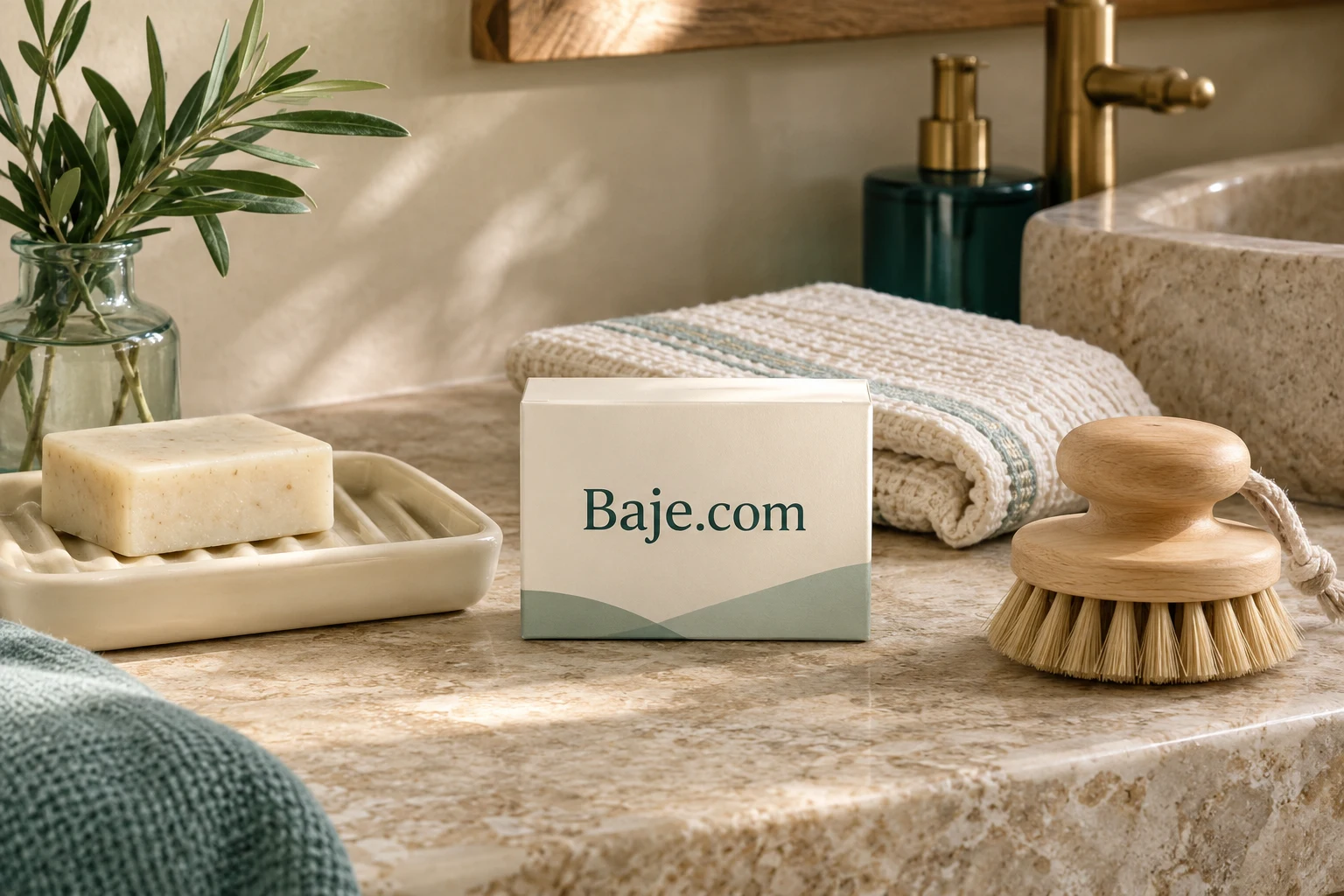
A bath collection can earn a place in a home through a modest object that works well every morning. Baje.com could become the identity for a considered line of bathroom accessories: a washable cloth, a soap dish or a compact countertop tray. This is an illustrative concept for a future buyer. No collection is currently being sold through this domain, and the acquisition offer concerns the domain itself.
Begin with an ordinary bathroom
The first customer might be someone furnishing a small bathroom who wants fewer mismatched objects on the counter. The useful research question is not which color feels luxurious. Ask what remains wet, what gets moved when cleaning, and what no longer fits beside the sink. Request measurements and photographs only with consent. A narrow counter and a shallow shelf can create product constraints that a large showroom bathroom conceals.
Choose one object from that research. A soap dish is a manageable starting point because its footprint, drainage and cleaning can be observed directly. It also has a clear limitation: it is an accessory, not a soap formula or a treatment. Starting with an accessory gives the founder a focused construction and cleaning problem to solve. A future founder can decide later whether a different product category is appropriate, after researching that category on its own terms.
Prototype drainage and cleaning
Imagine a ceramic dish with a shallow removable insert. The raised supports would let a bar rest above collected water, and both surfaces would come apart for cleaning. Before choosing a glaze palette, test whether a small bar tips between the supports, whether the dish slides on a wet counter, and whether someone can lift the insert without a tool. Those observations should guide dimensions and contact points.
Run the test in the intended setting. A controlled photograph can hide residue under an insert or water that escapes when the dish is moved. Ask users to follow their usual routine for several days, then inspect the object together. Record visible changes instead of asking only whether they liked it. If the design makes cleaning slower than an ordinary dish, the team needs to explain what extra benefit justifies that effort or change the construction.
Make materials legible
Material descriptions should help a buyer understand use and care. Give dimensions, weight where useful, surface information and instructions supported by testing. A founder should distinguish a manufacturer's statement from an independent certification. “Natural,” “clean” and “sustainable” can conceal different meanings. Replace those words with the actual material or a specific, supportable attribute. If the glaze has not been evaluated for a proposed use, resolve that question before promoting the use.
A cloth would bring a different set of decisions. The FTC's textile labeling guidance explains the U.S. framework for fiber, origin and responsible-business information on covered products. Product classification matters, so founders should check the guidance against the exact item rather than borrow a label from a different category. Accurate material information also gives customers a practical basis for comparing two similar-looking cloths.
Avoid a collection that outruns its evidence
The first range could contain one dish in two finishes. That keeps photography, packaging and stock decisions small enough to inspect. A tray should be added only if customer research reveals a separate job, such as containing frequently moved items. Selling a matching object is not automatically evidence that the object is useful. Coordinated colors can help a collection feel coherent, but each item still needs dimensions, a clear purpose and a sensible cleaning routine.
Replenishment should follow wear and actual usage. A durable ceramic item does not need a subscription simply because recurring revenue sounds attractive. A washable cloth may need replacement eventually, but the founder should not invent a schedule without evidence. Customer communication can focus on care, replacements for damaged pieces and compatible additions. The business model should fit the product's lifespan rather than encourage unnecessary purchases through vague hygiene claims.
Let a small shop teach the team
A credible first distribution test is a local home-goods retailer or a tightly focused online storefront. In a shop, watch how people pick up the sample. Do they turn it over to find its dimensions? Does the packaging let them understand the drainage design? Staff can report common questions, but direct observation prevents the founder from relying entirely on summaries. A small display with one clear use photograph may be more informative than a wall of interchangeable lifestyle images.
Online, show the dish empty, in use and taken apart for cleaning. Include a close view of its contact with the counter. The photography should reveal scale through an ordinary object, not an unusually small soap bar selected to flatter the design. Explain shipping protection and how a damaged arrival is handled. A fragile accessory needs a packaging test before a generous promise about safe delivery can become a routine customer experience.
Cost the object after it leaves the studio
Execution includes production tolerances, glaze consistency, breakage inspection, protective packaging and replacement handling. A prototype that looks excellent once may not translate into consistent units. Ask a supplier which differences are expected and which count as defects. Keep records of approved samples and inspect incoming stock. The product description should account for normal variation between pieces.
Build a sample packing sequence and ship test parcels using the intended carrier and packaging. Check the unpacking process as well as the arrival condition. Too much protective material can create frustration and costs that were missing from the original unit estimate. Work through an illustrative damaged-order scenario: who receives the report, what information is needed, and when a replacement is sent. A clear internal answer makes it easier to write an honest customer policy.
Keep the identity calm and the instructions clear
Baje could carry the collection name on a small stamp and a plain product card. The brand would have room for adjacent household objects while descriptive item names explain what each one does. Its compact form suits a small package, but packaging tests should still check readability. A distinctive identity helps recognition; the product must supply the reason to return.
The next step is to choose one non-cosmetic accessory, draw its dimensions, and test a rough sample in several ordinary bathrooms. Document the practical failures before refining its finish. To explore acquiring Baje.com for a bath and home brand, send a private inquiry with the intended product direction. Manufacturing, product rights and any additional creative assets would be separate from the domain acquisition.